20k
Professionals
Roca Group is a family-owned enterprise with a firm commitment to sustainable development that has been endorsed throughout its century-long history.
Evolution of key sustainability indicators
20k
Professionals
+80
Nationalities
89%
Permanent contracts
+363k
Training hours
8.4
Average satisfaction rating
4.1M
Beneficiaries of the We Are Water Foundation
-58%
Scope 1 and 2
CO2 emissions
(2018-2025)
-57%
Energy intensity
(2018-2025)
-56%
Water consumption
(2018-2025)
-59%
Waste generation intensity
(2018-2025)
69%
Electricity consumption from renewable sources
24
GWh of self-generated renewable energy per year
1,960
Business turnover
(M€ in 2025)
13.9%
EBITDA
(2025)
126
Current investments
(M€ in 2025)
1.65
Donations
(M€ in 2025)
25
Endowment to Roca Group Ventures (M€)
+850
Identified start-ups
(100 in 2025)
ROCA GROUP
Roca Group's Integrated Report delves into the company's progress regarding its sustainability strategy, focusing on its impact in three key areas: People, Planet, and Prosperity.
Download Integrated Report 2025Roca Group conducts a comprehensive annual assessment of its sustainability performance through EcoVadis, the global standard for business sustainability ratings, with more than 175,000 companies assessed.
In the June 2026 assessment, Roca Group achieved a score of 90 points, earning the Platinum Medal and placing in the top 1% globally for the second consecutive year.
This result marks our highest score to date and reflects progress across all four areas evaluated.
In addition, Roca Group reached the "Leader" category in EcoVadis’ Carbon Management assessment, the highest classification in this area.
The EcoVadis assessment covers 21 sustainability criteria across four core themes: Environment, Labor & Human Rights, Ethics, and Sustainable Procurement.
See this link for more details on Roca Group’s assessment and results, as well as EcoVadis’ rating methodology.
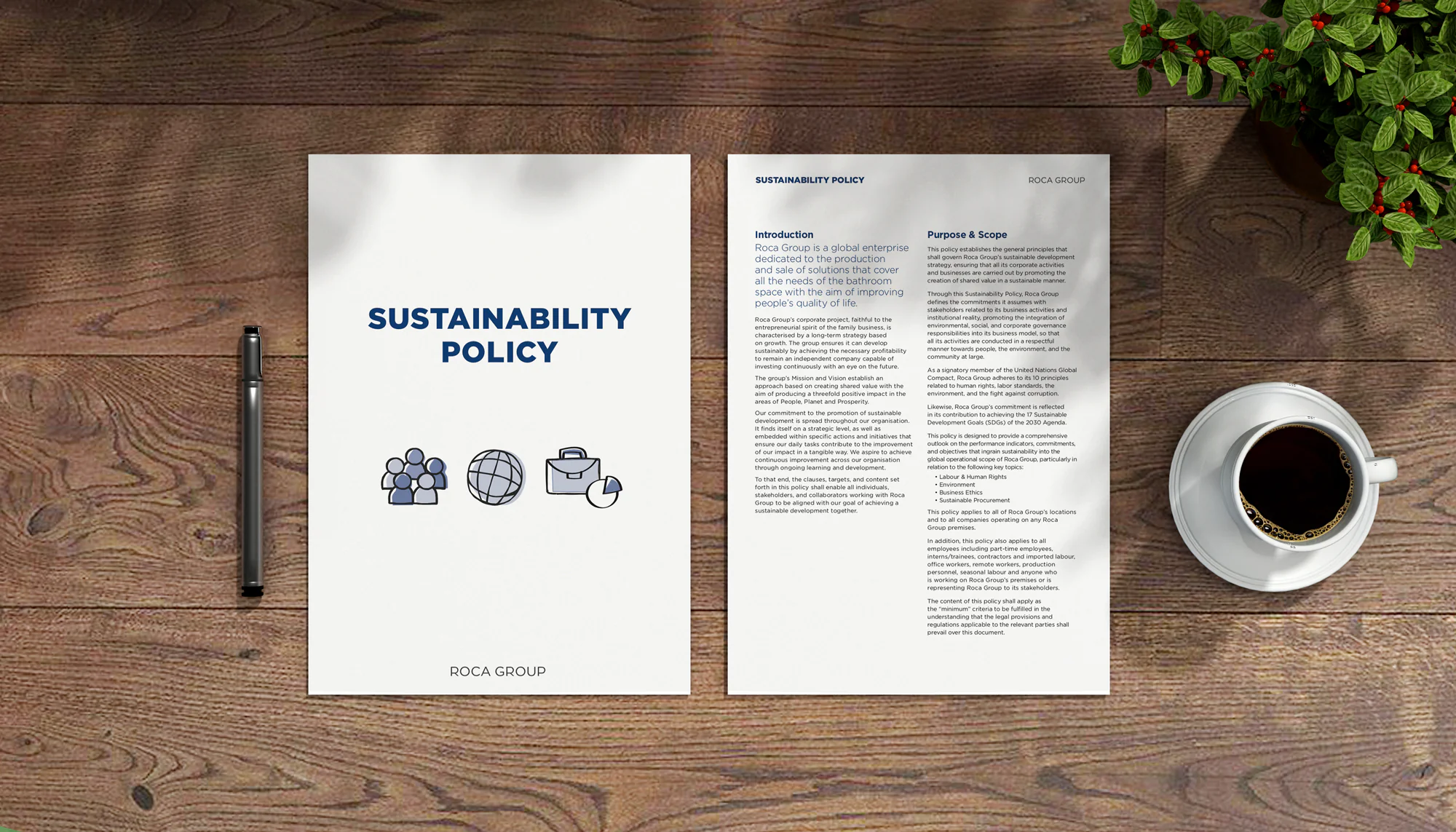
This policy establishes the general principles that shall govern Roca Group’s sustainable development strategy, ensuring that all its corporate activities and businesses are carried out by promoting the creation of shared value in a sustainable manner.
See Sustainability PolicyTo prioritize its efforts and facilitate strategic decision-making in environmental, social, and governance (ESG) matters, Roca Group has carried out a double materiality assessment in line with new regulatory and reporting requirements.
Based on the material topics identified in the double materiality assessment, Roca Group structures its sustainability roadmap into 9 lines of work that encompass them and serve as the foundation for the main initiatives and projects aimed at achieving its objectives.

Development of a safe and inclusive work environment based on well-being, diversity, training and the professional growth of employees.

Social, cultural and educational initiatives, including support for access to water and sanitation in vulnerable communities through the We Are Water Foundation.

Commitment to respecting and promoting human rights in our operations, value chain and relationships with stakeholders.

Progressive reduction of CO2 emissions through energy efficiency, renewable energy, industrial process transformation and value chain alignment.

Transition towards a circular model based on efficient resource use, waste reduction and valorization, and products designed for greater durability.

Development of innovative, eco-designed solutions that improve environmental transparency and product efficiency throughout the life cycle.

Growth based on profit reinvestment and the development of processes that ensure maximum operational efficiency and productivity.

Responsible supplier management based on environmental, social and ethical criteria that strengthen value chain resilience and sustainability.

Culture of integrity based on compliance, transparency, risk management and responsible decision-making across the business.
The sustainability governance model of Roca Group is designed to ensure effective management at all levels and operations. Through robust policies, monitoring mechanisms, and stakeholder participation, ethical decision-making, accountability, and the integration of sustainability into all organizational activities are promoted.


As a member of the UN Global Compact, sustainability forms an integral part of our commitment and we work in line with the targets of the Sustainable Development Goals.
Certificates and declarations