-
The group expanded its network of factories without emissions from energy consumption by completing the decarbonization of five new plants in Europe and the Americas during 2025.
-
The company now manufactures sanitary ceramics, faucets, seat and covers, bathtubs, shower trays and enclosures using exclusively renewable energy in its production processes.
Roca Group continues to advance in the decarbonization of its industrial operations through a strategy based on energy efficiency, electrification and the use of renewable energy sources. The company is driving this transition by leveraging technological innovation and process transformation.
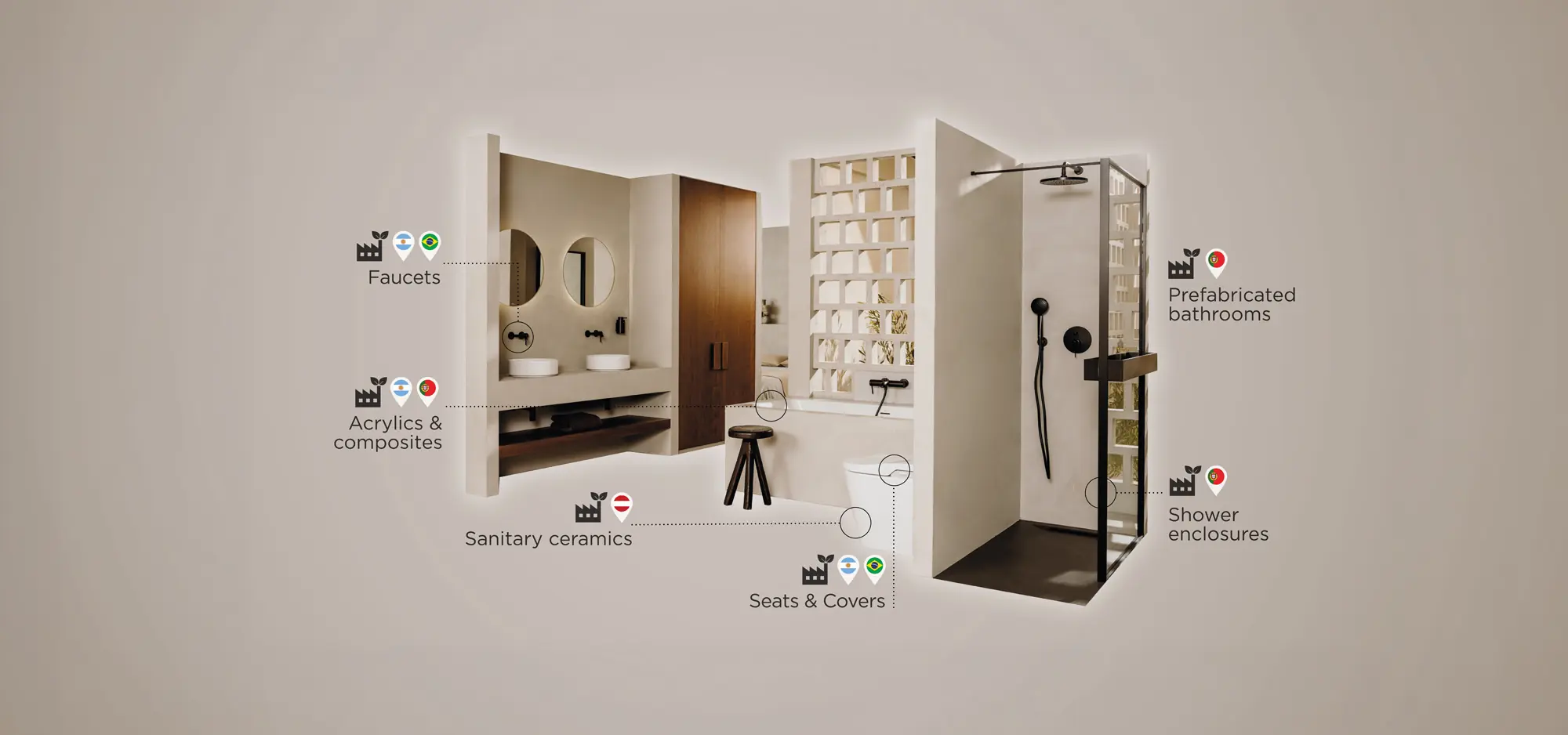
Currently, Roca Group already has nine factories without emissions from energy consumption, located in Austria (1), Portugal (3), Brazil (2) and Argentina (3). These facilities make it possible to manufacture all the products needed to equip complete bathrooms—including sanitary ceramics, seats and covers, faucets, bathtubs, shower trays and enclosures—in installations whose manufacturing processes generate no energy-related scope 1 and 2 emissions, demonstrating the viability of industrial decarbonization even in highly energy-intensive processes.
Technological innovation in high-temperature processes
One of the main milestones of this transformation has been the commissioning in 2023 of the world’s first electric tunnel kiln for the production of sanitary ceramics at the Gmunden plant (Austria). This technology eliminates the use of fossil fuels in the firing stage—which exceeds 1200°C—and has made this facility the world’s first sanitary ceramics factory operating with zero emissions from energy consumption.
The new system replaces conventional gas-fired kilns with a fully electric process, enabling the manufacture of basins and toilets without energy-related emissions and opening up new opportunities in other segments of the ceramics industry. Before this transformation, the plant emitted around 5,000 tonnes of CO₂e per year; today, it operates without emissions, using exclusively renewable electricity supported by a photovoltaic installation of 5,000 panels that covers 20% of its energy consumption.
In addition, this technology improves process efficiency, reducing energy consumption per unit produced without compromising quality.
Electrification and energy efficiency
The decarbonization strategy extends to the faucets business—with operations in Spain, Portugal, Switzerland, Italy, the Czech Republic, Turkey, Egypt, China, India, Brazil and Argentina—where electrification and optimized energy management have enabled significant progress. In 2025, this business reduced its emissions by 7.6% compared to the previous year, with 58% of electricity consumption from renewable sources, of which 18% is self-generated. The plants in Vitoria de Santo Antão (Brazil) and Lanús (Argentina) stand out as the group’s first fully electric faucets factories, achieving zero energy-related emissions in their production processes.
In acrylics and composites—with a presence in the United States, Argentina, Egypt, Poland, Bulgaria and Portugal—Roca Group achieved a 70.2% reduction in emissions in 2025, driven by greater use of renewable electricity, which accounts for 80% of consumption. This business has two factories with no energy-related emissions in Portugal and Argentina. At the Anadia plant (Portugal), the shower enclosures factory was designed from the outset to operate with zero emissions from energy consumption and to meet its energy needs through renewable electricity generated by its own photovoltaic installation, embedding sustainability from the industrial design phase.
A transforming industrial model
Overall, these advances respond to a strategy aimed at transforming the production model, strengthening Roca Group’s competitiveness and its ability to anticipate future challenges. They also contribute to decarbonization targets aligned with science-based criteria and validated by international organizations such as the SBTi.
This model reduces exposure to energy price volatility and improves cost predictability, consolidating a more efficient and resilient system. Experience shows that the transition to a low-carbon industry can be pursued ambitiously, even in sectors with high energy requirements, and that solutions based on innovation, electrification and renewable energy are scalable and replicable across other industrial fields.